Empowering Food Security in Remote Communities with Generative AI
Role:
Design Lead
Client:
Food Ladder
Industry:
Education / Non-profit
Date:
Result:
Live
Key Responsibilities
- Faciltated in-person design thinking workshops with Food Ladder CEO & operations team - UX/UI conversational design leveraging IBM Carbon Design system - Project managed team of engineers
AI-powered solutions designed for Food Ladder to automate onboarding and lesson plan generation. The solution helped unlock Food Ladder's ability to reach 400+ schools in need across remote communities. Built on IBM watsonx, both solutions progressed from PoC to production: Onboarding assistant live soon at: https://foodladder.org Food Ladder Teaching Hub live now at: https://www.foodladdertech.org The prototype below was independently rebuilt for this portfolio using Claude Code.


Production build:
Portfolio prototype:

The problem space
Food Ladder builds hydroponic greenhouses in remote Australian schools - where a single greenhouse can supplement up to 85,000 meals. The impact was real: at Wellington Public School in Western NSW, student attendance went from 30% to above 90% after joining the program. With 94% of Australian children not eating enough fresh food, and food access even more dire in remote Indigenous communities, the demand and gap were clear.
With 40 schools backlogged and thousands more in need, the organisation was running on a team of two. Every new school required a 40-minute intake call, manual onboarding, and hand-delivered infrastructure. Teachers needed lesson plans built from scratch. Impact data was collected by hand. There was no self-serve, no automation - and no way to reach 1,000 schools without fundamentally changing how the work got done.

Our target user
Through design thinking workshops, two distinct user groups emerged as central to Food Ladder's scaling challenge: the internal team managing school engagement, and the teachers responsible for delivering the program.
With only two people overseeing onboarding and deployment nationally, every new school compounded the same small team's load. Teachers faced a parallel pressure - many already stretched across teaching, pastoral care, and supporting students who arrive hungry and disengaged. Building curriculum content from scratch wasn't just an inconvenience. It was a barrier to the program reaching the kids who needed it most.
Designing for both created a multiplying effect: streamline the Food Ladder team's processes and more schools get access; reduce teacher overhead and the program actually gets used.

Opportunity
With demand growing toward thousands of schools and a target of reaching one million students by 2030, the opportunity was clear: use AI to remove the manual bottlenecks standing between Food Ladder and global scale.
Through design thinking workshops, we mapped the full landscape of potential AI interventions and prioritised by impact and feasibility. This led us to focus on two areas: automating school onboarding to shift engagement from a manual, time-intensive process to one that ran continuously without added headcount, and giving teachers the ability to generate curriculum-aligned lesson plans on demand - transforming Food Ladder from a greenhouse provider into a genuine classroom partner.

Results
With AI removing the operational ceiling, Food Ladder is now on a path to grow from supplementing 100,000 meals in 2024 to 25 million annually by 2030 - reaching 1,000 schools and over one million students across Australia and beyond.
For the Food Ladder team, inbound school inquiries could be handled with minimal staff involvement, freeing them to focus on higher-value work. For teachers, lesson plans that once required significant preparation time became available on demand - giving them more space to focus on showing up for their students.

The solution
The Food Ladder platform was built on IBM watsonx Assistant and watsonx.ai, delivering two fully prototyped AI solutions. The onboarding virtual assistant replaced the manual intake process - allowing schools to self-serve through a conversational flow that triaged interest, gathered context, and logged deployment tickets automatically. The lesson plan generator gave teachers curriculum-aligned content on demand, tailored by year level, subject, and individual class needs, reducing what once took significant preparation time to minutes. Responsible AI was considered throughout. Both products use retrieval-augmented generation to ground outputs in Food Ladder's own verified content, with built-in traceability so users can see the source behind any answer. Human escalation pathways were designed into every flow, keeping the Food Ladder team in control where it mattered most.
The design process
The Food Ladder platform was developed using a human-centred design approach in close collaboration with the CEO and Head of Partnerships from the Food Ladder team, who were engaged throughout discovery, ideation, and validation. Through design thinking workshops, we developed a customer journey map spanning the full school lifecycle - from awareness and onboarding through to growing, teaching, and community sharing - to surface friction points at every stage. Needs statements were crafted to reframe pain points as actionable design opportunities, ensuring solutions were grounded in real user needs rather than assumptions. Prototypes were validated with stakeholders, with particular attention to how non-technical users like teachers would experience the flows - including decisions around progressive information gathering and when to escalate from a virtual to a human agent.

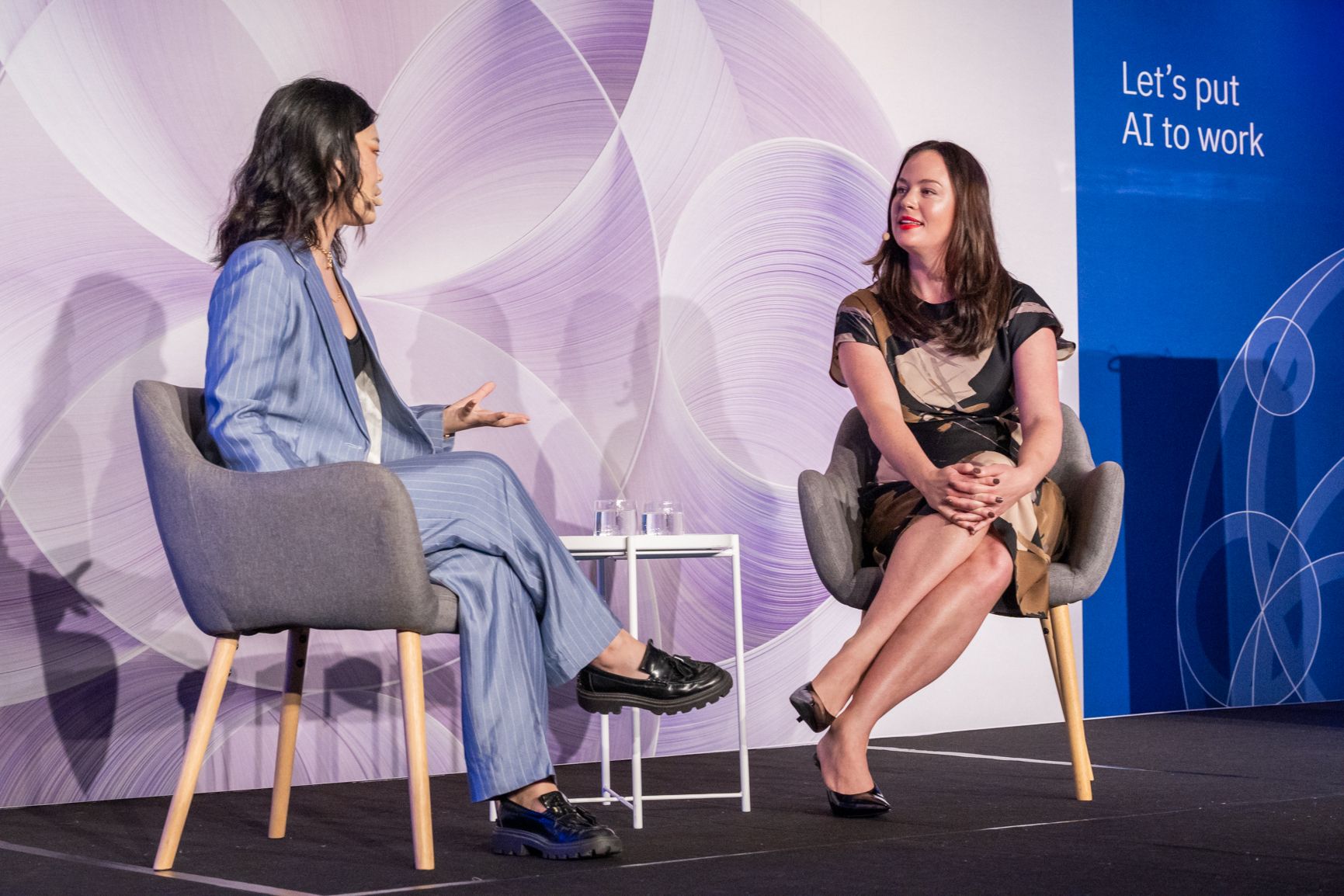
Presented at IBM AI Summit, Sydney 2024